
Read more
Strategy & Insights
Private affiliate network: What it is and when it pays off
Your own partner network instead of network fees: what a private affiliate network is, who it makes financial sense for and how to approach the switch.

November 6, 2026
A private affiliate network is a partner program you run yourself: with your own tracking technology, your own contracts with your publishers and no public affiliate network in between. It pays off above all if you already have a strong partner base and want to manage those relationships yourself, if network fees make a noticeable dent in your budget, and if you want to keep control of your customer and partner data.
In this guide, you'll learn how a private network works, how it differs from networks such as Awin or Tradedoubler, what it really costs and which criteria help you decide whether the move makes sense for you. We're writing from more than 15 years of hands-on experience: that's how long retailers like DOUGLAS have been running their partner programs on our technology.
Key takeaways
- In a private network, you are your publishers' contractual partner, not the network.
- Instead of paying a fee on every sale, you pay for software and internal operations.
- It usually pays off once you reach significant affiliate volume and know your most important partners.
- You don't have to choose between a network and a private network: many retailers combine both.
What is a private affiliate network?
A private affiliate network (often shortened to “PVN” or “private network”) is a closed partner program controlled by the advertiser. You decide which publishers take part, on what terms they work and how clicks, sales and commissions are recorded. The technical foundation is affiliate software that handles tracking, partner management and billing.
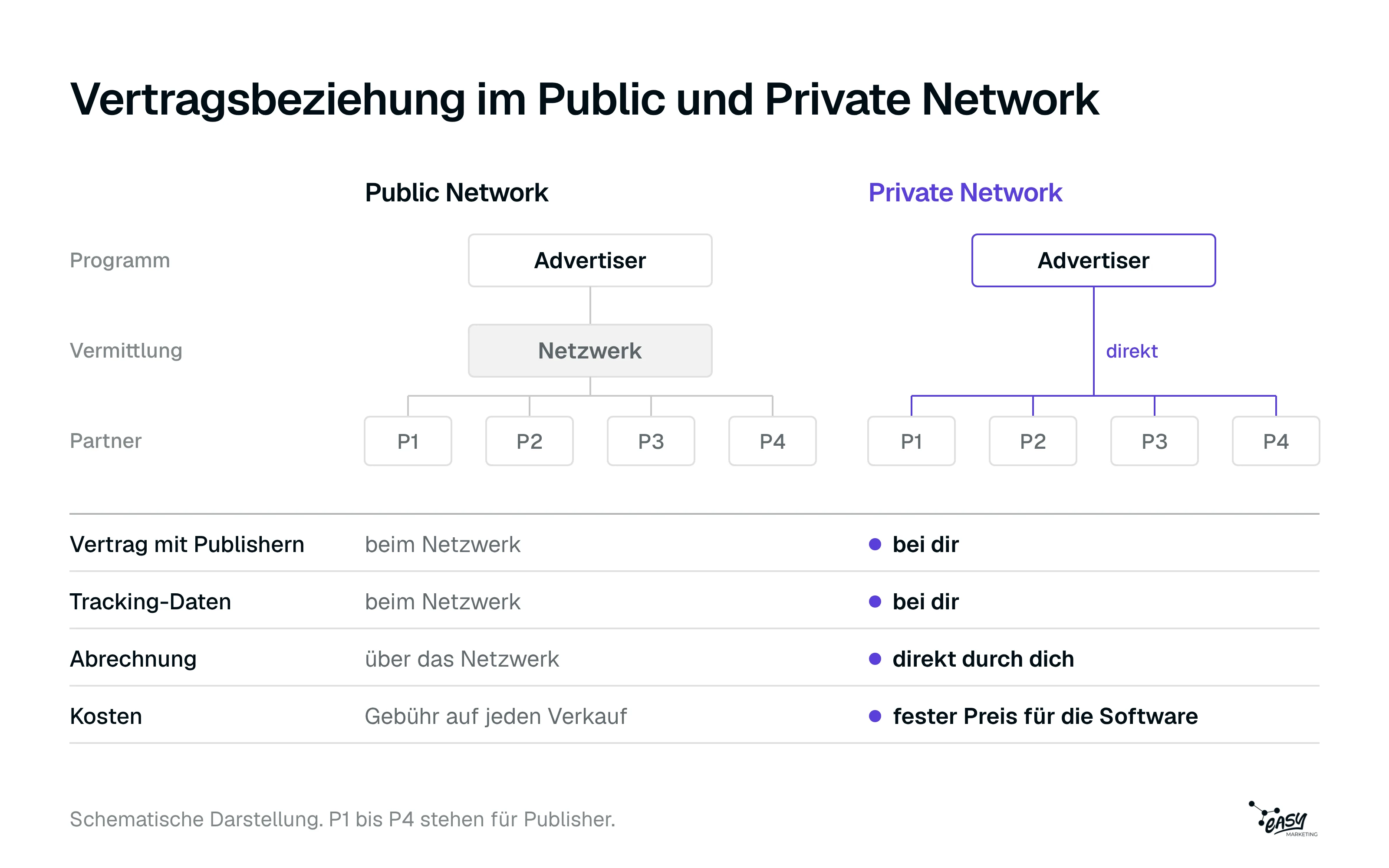
The key difference lies in the contractual relationship. In a public network, your publishers sign their contract with the network, which handles billing and holds the data. In a private network, you sign the contracts directly. Alicia Schmidt, Affiliate Manager at the DOUGLAS Group, sums it up:
“With our own network, we are the contractual partner, the point of contact and the sender all in one.”
Private network, public network, in-house program: the terms clearly defined
The industry uses these terms inconsistently. Here's how we define them in this article:
- Public network (public affiliate network): A marketplace such as Awin, Tradedoubler or ADCELL. Advertisers and publishers meet on a shared platform; the network handles tracking, billing and the contractual relationship and earns a cut of every transaction.
- Private affiliate network: Your own program on licensed software, under your brand and domain. The technology comes from the software provider; strategy, contracts and data stay with you.
- In-house build: You develop tracking, the partner portal and billing yourself. Very few companies do this, because development and maintenance tie up a lot of time and budget.
- White-label solution: Software that runs entirely under your branding. Good private network software is usually white-label capable, which is why the terms overlap.
One example of such software is easy.AFFILIATE by EASY-M, which DOUGLAS, OTTO and MediaMarktSaturn, among others, use to run their partner programs.
How a private affiliate network works
Technically, a private network works much like a public network, except that every component is your responsibility:
- Publisher onboarding: Partners apply through a partner portal on your domain or are invited directly. You review and approve every application.
- Ad materials and links: In the portal, publishers find banners, vouchers, product data and tracking links. Good software imports product data automatically from your shop or ERP system and generates a tracking link for each product.
- Tracking: When a user clicks a partner link, the click is recorded and assigned to the publisher. Modern systems do this server-side via a subdomain of your shop (first-party tracking) instead of relying on third-party pixels. This makes tracking more resilient to ad blockers and browser restrictions such as Apple's ITP.
- Conversion and validation: When the user makes a purchase, the order is attributed to the click. Cancellations, returns and approvals flow back from your shop, ERP or CRM, so commission is paid only on genuinely valid revenue.
- Billing: Credit notes and payouts to publishers are generated, checked and approved, ideally automatically.

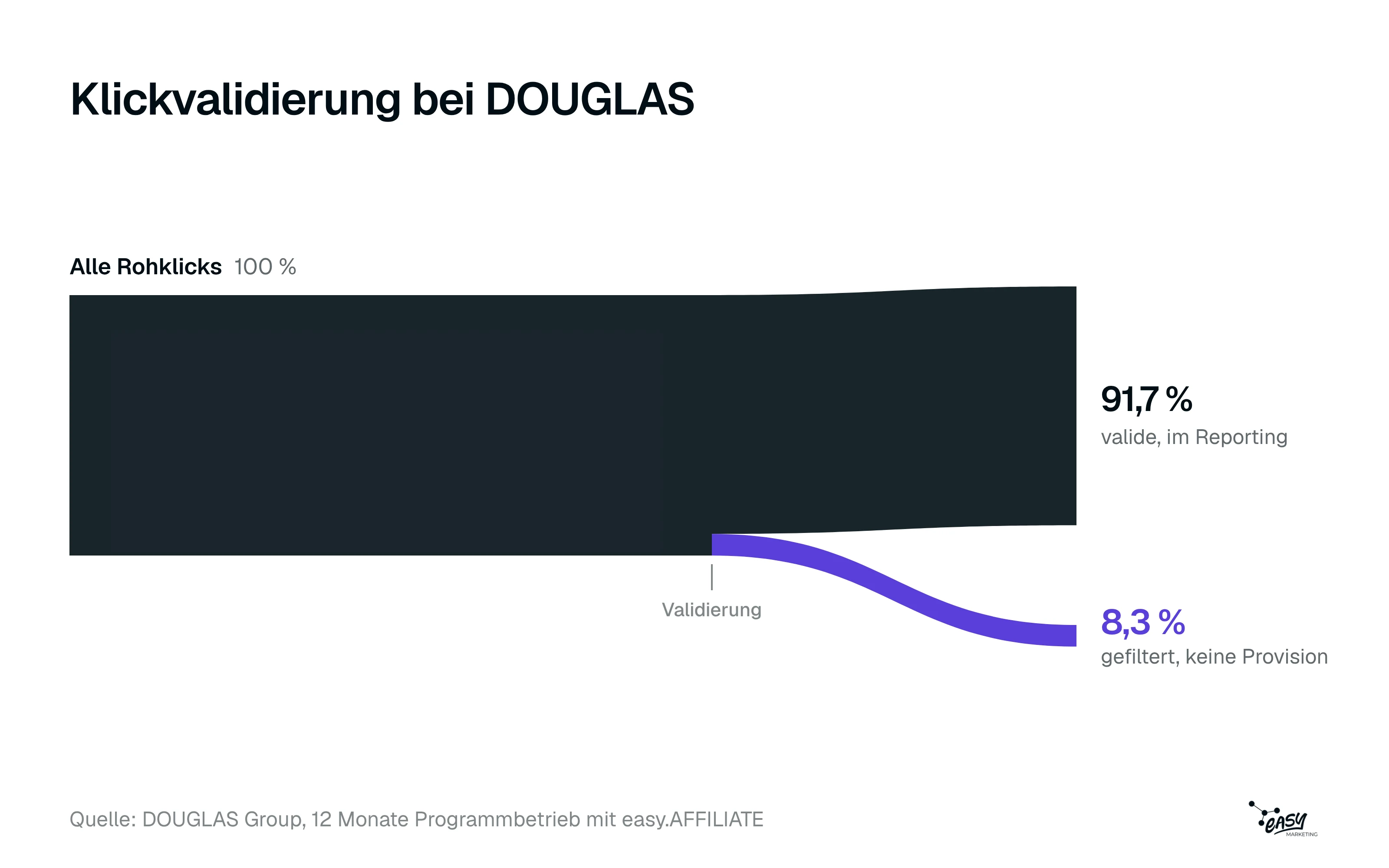
The DOUGLAS case shows how important clean validation is: of all incoming raw clicks, 8.3% turn out to be bots, crawlers or duplicates and are filtered out before they reach reporting. Commission is paid only on the remaining 91.7%.
We explain why tracking via your own subdomain is so much more stable in Benefits of first-party tracking with subdomains.
The benefits of a private affiliate network
No fee on every sale
Public networks usually take a percentage of your revenue. Awin, for example, lists on its pricing page a monthly base fee plus a tracking fee of 3.5% of the transaction value in its entry-level package and 2.5% in the next tier up, in each case on top of the publisher's commission (as of November 2026, UK market). For larger programs, terms are negotiated individually.
What matters is not the size of the percentage but the logic behind it: the fee grows with every euro your partners generate. The more successful your program, the more you pay for the same infrastructure. That also applies to revenue you would have made anyway, such as existing customers who buy again via a voucher link.
In a private network, you pay for the software instead. With easy.AFFILIATE, that's a fixed monthly price per package that doesn't grow with your partner revenue. This makes your costs predictable, and every additional euro of revenue from the partner channel directly improves your margin. The sample calculation below shows how big the difference is for your program.
Your data stays with you
Click, transaction and publisher data sits in your system, not with a third party that sees the same data across many advertisers. This matters in two ways.
Strategically, you can work with raw data instead of just ready-made reports: Which partners bring in new customers, and which mainly bring existing ones? How long is the customer journey for voucher sites compared with content publishers? You can also feed this data straight into your data warehouse or BI system and combine it with the rest of your marketing data.
On data protection, you know exactly which data is processed where, and fewer parties are involved. When choosing software, look for EU hosting, ISO 27001-certified data centers and a data processing agreement under Art. 28 GDPR. That way, you remain the controller, and the software provider processes the data only on your behalf.
Direct relationships with your most important partners
Whether you have 30 publishers or 3,000, in a private network you negotiate with your partners directly, without going through a network's account management. The software scales with you. What matters more is how many partners you want to manage directly yourself.
In practice, this means you can offer a large comparison portal a higher commission for new customers, give a content publisher exclusive vouchers for a campaign, or set up a tiered bonus for a cashback partner once they hit a certain revenue threshold. You settle questions about commissions or missing transactions directly instead of sending tickets through the network. Publishers apply via your partner portal, under your brand and on your domain, so they know from day one who they are working with.
That is exactly what DOUGLAS means by "contractual partner, point of contact and sender all in one". For top partners, a direct relationship is often more attractive than being one of many campaigns on a marketplace.
Complete freedom in commission models
Networks often impose a fixed framework. In your own system, you can differentiate commissions in whatever way suits your business: by country, publisher type, campaign, product category or even individual products.
Three examples that come up especially often in practice:
- New vs. existing customers: You pay more for a new customer than for one who already buys from you regularly. This rewards partners who genuinely bring you new reach.
- Margin-based commissions: You can be more generous for high-margin product categories than for products where you earn little.
- Your own cookie duration: You decide how long a click counts. For products with a long decision phase, a longer duration ensures that later purchases are still attributed to the partner.
On top of that come rules that prevent disputes: voucher codes are automatically assigned to the right publisher, and with a frozen basket value (basket freeze), the commission is calculated on the value at the time of the order. A tip: differentiated commissions only pay off once you know your margins per product category. Otherwise, the model becomes complicated without generating more revenue.
Attribution on your own terms
If a customer clicks links from several partners before buying, the attribution model decides who gets the commission. Many networks apply "last cookie wins": the last click takes it all. This favors voucher and cashback portals that step in just before the purchase and puts content publishers at a disadvantage, even though they were the ones who made the customer aware of your offer in the first place.
In your own network, you decide how conversions are credited:
- First click or last click: You reward either the partner who won the customer or the one who closed the sale.
- Position-based or proportional: The commission is split among several partners along the customer journey.
- Custom rules for each partner type: For example, a voucher portal that only appears after a content partner's click receives a reduced commission or none at all.
- Optional post-view: Views, such as banner impressions, can also be factored in.
With easy.AFFILIATE, you can choose any attribution model. If none of the standard models fits your program, we'll work with you to develop custom attribution rules. Make sure you disclose the rules in your terms of participation: partners are more likely to accept a model if they know about it in advance.
More control over quality and fraud
In a network, you usually only see the result, not the raw data behind it. In a private network, you decide on every partner application yourself and can trace every click all the way to the order.
This exposes typical fraud patterns: cookie dropping, where tracking cookies are set without a genuine click, or voucher leaking, where exclusive voucher codes end up on voucher sites and trigger commissions there. Good software automatically checks every click before it enters reporting, tests the tracking regularly and raises an alert when it detects unusual spikes or tracking outages.
At DOUGLAS, this filters out 8.3% of raw clicks as bots, crawlers or duplicates before they can trigger a commission. Keep in mind, though: technology alone is not enough. Your terms of participation must clearly state which advertising formats are allowed and when commissions will be cancelled.
Scaling across borders
If you sell in several countries, you know the problem: in a network, each market gets its own program, with its own publisher list, its own ad materials, its own reporting and often its own contract. Large networks even require a separate login for each country. The effort grows with every country, and getting an overview of all markets takes manual work.
A private network can cover several markets in a single installation. DOUGLAS, for example, runs five countries (Germany, Austria, Switzerland, Belgium, Poland) as client accounts in one system. The countries remain cleanly separated, with their own terms, currencies and partner portals, but are managed from one place. A new market is simply an additional portal in the existing installation, not a new contract or a new setup.
The downsides and the effort involved
A private network doesn't run itself. Before you decide, you should know the flip side:
- You recruit publishers yourself. A public network comes with a marketplace of thousands of partners. In a private network, you have to recruit actively. If you already know your key partners, that's not a big issue, but if you're starting from scratch with no partner base, it's a real hurdle.
- You need capacity for partner management. Someone has to look after partners, negotiate terms and steer the program. That said, the same applies in a network: if you want to scale seriously there, you can't do without your own partner management or a supporting agency either.
- Contracts and compliance are your responsibility. You have to define the terms of participation, data protection roles and payout rules yourself.
- The switch takes planning. If you're moving away from a network, you need to coordinate notice periods, the tracking migration and publisher communication carefully.
The operational effort depends heavily on the software. The more it automates, the fewer staff you need. At DOUGLAS, day-to-day operations are 99.85% automated: the team only steps in for exceptions.
When does a private affiliate network pay off?
The honest answer: not for everyone. Whether a private network pays off depends mainly on three factors: your affiliate volume, the structure of your publisher base and your resources.
Sample calculation: network fees compared
The following example shows how sharply network fees grow with revenue. For simplicity, we assume a network markup of 3% on affiliate-generated revenue, with no base fee. We leave out the publisher commission because it applies in both models.

Assumption for illustration purposes. Your actual terms may differ.
On the other side of the equation, a private network involves the software license and internal effort, for example for partner management. For your own calculation, you need:
- your annual affiliate revenue and your current network costs (markup plus base fees),
- the software price for your program,
- the additional internal effort in person-days or FTE share,
- one-off costs for setup and migration.
Rule of thumb: Once your annual network costs are well above the software license plus additional staffing costs, it's worth taking a closer look.
Checklist: Is a private network right for you?
The more questions you answer with yes, the more likely the move will pay off:
- ☐ Do you have a strong existing partner base?
- ☐ Do you know your key partners personally or have direct contact with them?
- ☐ Are your annual network costs in the five- or six-figure range?
- ☐ Do you have someone who actively manages the partner program?
- ☐ Do you want to control commissions in more detail than your network allows?
- ☐ Are data ownership and GDPR control particularly important to you?
- ☐ Do you operate in several countries and want to manage the programs centrally?
- ☐ Are you facing tracking gaps or partner quality issues in your current network?
When it doesn't pay off (yet)
If you're just starting out with affiliate marketing, don't have any partners yet and your volume is small, a public network is often the better entry point. You gain reach quickly and learn which publisher types work for you. You can plan the move to a private network later, once your program has grown. For a detailed comparison, see Public vs. private affiliate network: pros and cons.
Hybrid model: combining private and public networks
Many large retailers don't choose one or the other – they use both: their key publishers work directly in the private network, while the long tail stays in the public network. This way, you save fees where most of the volume is, and keep the marketplace's reach for smaller partners you can't look after individually.
The best way to decide which partner belongs where is to use a few simple criteria:
- Move to the private network: partners with a high share of revenue, partners you want to agree individual terms or exclusive promotions with, and partners where a direct relationship matters to you.
- Keep in the network: the many small publishers with low individual volume, and partners you want to test via the marketplace before managing them directly.
The biggest challenge is attribution: if a customer clicks links from both channels, the commission must not be paid out twice. Central tracking and clear attribution rules that apply to both channels solve this. To make this work, easy.AFFILIATE automatically imports transactions from networks such as Awin, Tradedoubler or ADCELL. All data comes together in one place, giving you a single source for reporting and billing.
The hybrid model is often the smoothest way to get started, too: you begin with a handful of top partners in the private network and move more publishers over step by step once your processes are in place.
Case study: the DOUGLAS Group's private network
The DOUGLAS Group has run its partner program on its own network, powered by EASY-M technology, since June 2011. The starting point is typical of international retail: lots of partners, several countries and commission models that differ from market to market. In conventional setups, every new country means separate publisher lists, separate creatives and separate reporting.
The solution: All markets run as client accounts in a single installation. Creatives, vouchers, product data, tracking and billing are managed in one place, while the countries remain cleanly separated. Every click is checked before it enters reporting.
The results:
- 15 years of partnership and program operation
- 5 active markets in one installation
- 99.85% automation in day-to-day operations
- 8.3% of clicks filtered out as bots, crawlers or duplicates before they trigger a commission
- 3.4 times the click volume on Black Friday 2025 compared with the daily average, processed with the same configuration as on any other day
- Predictable costs thanks to a fixed-price license, regardless of program revenue
You'll find all the details in the DOUGLAS use case.
Your own private network in 6 steps
- Take stock: Which publishers generate which revenue? What does your network really cost you today?
- Build the business case: Compare network costs with software and internal effort.
- Choose your software: Check tracking, billing, partner portal and integrations (see next section).
- Define terms and contracts: Commission model, terms of participation, data protection roles.
- Migrate and recruit partners: Reach out to top publishers from the network and recruit new partners.
- Launch and optimize: Run both setups in parallel during the transition, then monitor and optimize continuously.
If you're already in a network, our article Switching affiliate networks: the right time will help you plan.
What to look for in the software
The software determines how much effort your private network takes day to day. Check every provider against these criteria:
- Server-side first-party tracking via your own domain instead of third-party pixels
- Automatic sales reconciliation with your shop, ERP or CRM, so cancellations and returns are taken into account automatically
- Automated billing with credit notes, payout runs and an approval process
- Flexible commission logic by country, partner, product, and new vs. existing customer
- Partner portal under your brand and your domain
- Monitoring and fraud detection with automated tracking tests and alerts
- Multiple markets in one installation
- Data protection: Hosting in the EU, a DPA under Art. 28 GDPR, ideally a data protection audit
- Pricing model: Fixed price or revenue-based fee?
- Integrations with your existing systems and with affiliate networks
FAQs about private affiliate networks
How much does a private affiliate network cost?
You pay for the software and internal operations, but no fee on every referred sale. Software costs depend on the feature set; with easy.AFFILIATE, it's a fixed monthly price per package. On top of that come the effort for partner management and one-off costs for setup and migration.
Do I still need an affiliate network?
Not necessarily. But many retailers combine the two: top partners in the private network, the long tail in the network. In that case, a central data basis is essential so commissions aren't paid twice.
How do I find publishers without a network?
Through your existing partner contacts, by approaching relevant websites and creators directly, with a public application page and at industry events. Some software also offers its own marketplace where partners can find you.
Is a private network GDPR-compliant?
That depends on how it's implemented, not on the model. One advantage: fewer third parties are involved, and you stay in control of the data flows. Make sure you have EU hosting, a data processing agreement and proper integration with your consent management. We explain which cookies require consent in Cookie consent: legal basis & consent layer.
How long does the setup take?
That mainly depends on how your systems are connected and how many partners you migrate. Plan for a transition phase in which the network and the private network run in parallel. We're happy to draw up a realistic timeline for your program in an initial consultation.
Can I take my publishers with me from the network?
Yes, publishers aren't tied to the network. But first check your network contract for notice periods and exclusivity clauses, and inform your partners early about the switch and their new terms.
Conclusion
A private affiliate network puts you back in control of your partner program: its costs, its data and your relationships with your most important publishers. It pays off above all for advertisers with significant affiliate volume, a clear partner structure and someone who actively manages the program. For newcomers without a partner base, a public network is often the better place to start, and those who are already large often do best with a combination of both.
Want to know whether a private network pays off for your program? In a free initial consultation, we'll look at your publisher structure, your commission models and your actual network costs. Book a demo
Written by
Anja Heinicke
Head of Customer Success
Anja Heinicke is Head of Customer Success at EASY-M. As a former agency team lead at Artefact and in-house manager for global partnerships at Yazio, she spent years running campaigns herself. Today, she bridges the gap between tech and business for brands such as OTTO, MediaMarktSaturn and DOUGLAS.
Next step
Let's talk about your setup
In an initial call, we'll look at your goals together and show you which solution is right for you.
Tracking, web analytics and affiliate
Software and team based in Dortmund
Hosting exclusively in the EU
easy.AFFILIATE
Your own partner program, with no fee on every sale
Tracking, sales reconciliation and billing in one software. In use at DOUGLAS for more than 15 years.
Fixed price instead of network fees
Partner portal under your brand
Hosting exclusively in the EU


