
Read more
Strategy & Insights
Affiliate networks vs. your own partner program: an honest comparison
Network or your own partner program? What affiliate networks do, which ones are out there, and when going your own way pays off.

November 23, 2026
An affiliate network is a marketplace that brings together advertisers (shops and brands that want their products promoted) and publishers (websites, creators and portals that promote them in return for commission), and handles tracking, contracts and billing for both sides. Your own partner program, on the other hand, is one you run yourself, with your own software and direct contracts. Which route works better depends mainly on whether you already have partners, how much revenue the channel generates and who manages the program internally.
In this article, we explain what affiliate networks do, which ones operate in the German-speaking market and how they differ. We then compare networks and your own program across six criteria and use a decision matrix to show which model suits which kind of company.
Key takeaways
- Networks bring reach and take care of tracking and billing, but in return they earn on every sale they generate.
- Your own partner program gives you control over terms, data and partner relationships, but requires more work on your side.
- If you are just starting out and have no partner base, a network is often the right way in.
- If you know where your most important partners come from, you are usually better off with your own program or a combination of both.
What is an affiliate network?
An affiliate network is a platform that acts as an intermediary between advertisers (shops, brands, service providers) and publishers (websites, voucher portals, creators, comparison portals). The advertiser lists its partner program there, publishers apply, and the network makes sure every sale is attributed to the right partner and paid out.
There are three roles in a network:
- Advertiser: sets the commissions, ad materials and terms of participation, and pays for the sales or leads generated.
- Publisher: promotes the offers on its channels and earns a commission in return. Many people now say partners instead of publishers, because the collaboration often goes beyond pure advertising. Both terms mean the same thing.
- Network: provides the technology, handles billing and is the contractual partner for both sides.
That last point is often overlooked: your publishers have their contract with the network, not with you. The network pays them, holds the data and is their first point of contact.
In your own partner program, the network's role disappears: a software provider such as EASY-M supplies the technology, while contracts, payouts and partner management sit with the advertiser itself or with an agency.

How do affiliate networks make money?
Networks usually earn money in three ways, often in combination:
- Setup fee for launching the program
- Monthly base fee for the platform and support
- Surcharge on every transaction, either as a percentage of the revenue generated or as a share of the publisher commission
Awin, for example, lists on its pricing page a monthly fee plus a tracking surcharge of 3.5% of the transaction value in its entry-level package (as of November 2026, UK market). For large programs, terms are negotiated individually. What matters is the principle: the fee grows as your channel succeeds.
Which affiliate networks are there?
The German-speaking market has a few large generalists and several specialist networks. The following overview gives you a first orientation:
| Network | Focus | Typical for |
|---|---|---|
| Awin | Generalist, very large publisher base, international | Retail, fashion, travel, telecoms |
| Tradedoubler | Generalist with a European focus | Retail, travel, international programs |
| ADCELL | Generalist from Germany | Shops of all sizes, many smaller programs |
| belboon | Generalist from Germany | Retail and lifestyle |
| financeAds | Specialist in financial products | Banks, insurance, loans |
| CJ (Commission Junction) | International, strong in the US | Brands with an international program |
| Digistore24 | Marketplace for digital products | Online courses, software, e-books |
In addition, many retailers run their partner program without any network at all: on their own affiliate software or, like Amazon, on a fully in-house solution.
How do the networks differ?
When you compare networks, pay particular attention to these points:
- Publisher base: Are the partners you need active there? A finance network has different publishers than a fashion generalist.
- Fee model: How high are the setup fee, base fee and surcharge, and what is the surcharge calculated on?
- Tracking: Does the network use first-party tracking via your domain, or does it rely on third-party cookies?
- Support: Do you get account management, or are you on your own?
- Countries: Do you need a separate program for each country, with its own login and its own billing?
Whichever network you choose, the basic model stays the same. That is why it is worth asking whether you need a network at all.
Network, your own program or both: the three models
There are basically three ways to run affiliate marketing:
- Public network: You list your program in a network. The network provides the technology, reach and billing.
- Your own partner program (private network): You run the program on your own licensed software under your brand. Contracts, data and terms stay with you. The technology comes from affiliate software such as easy.AFFILIATE by EASY-M, which DOUGLAS, OTTO and MediaMarktSaturn, among others, use to run their partner programs. We explain how this works in detail in our guide to the private affiliate network.
- Hybrid: Bring your top publishers into your own program. That saves you the network fee on a large share of your revenue and lets you negotiate individual terms with each partner. At the same time, you stay active in the network to find new publishers and cover the long tail of many small partners. This pays off especially when a few partners generate most of your affiliate revenue.
Network vs. your own partner program
| Criterion | Affiliate network | Your own partner program |
|---|---|---|
| Costs | Fees grow with every sale | Fixed software price |
| Partner access | Large marketplace, quick start | Recruit and invite partners yourself |
| Control | Within the network's framework | Set your own terms and rules |
| Data ownership | Data sits with the network | You own the raw data |
| Effort | Depends on the network; account management often costs extra | More in-house work, depending on the software |
| Tracking | Depends on the network | Your own domain, first-party possible |
Costs
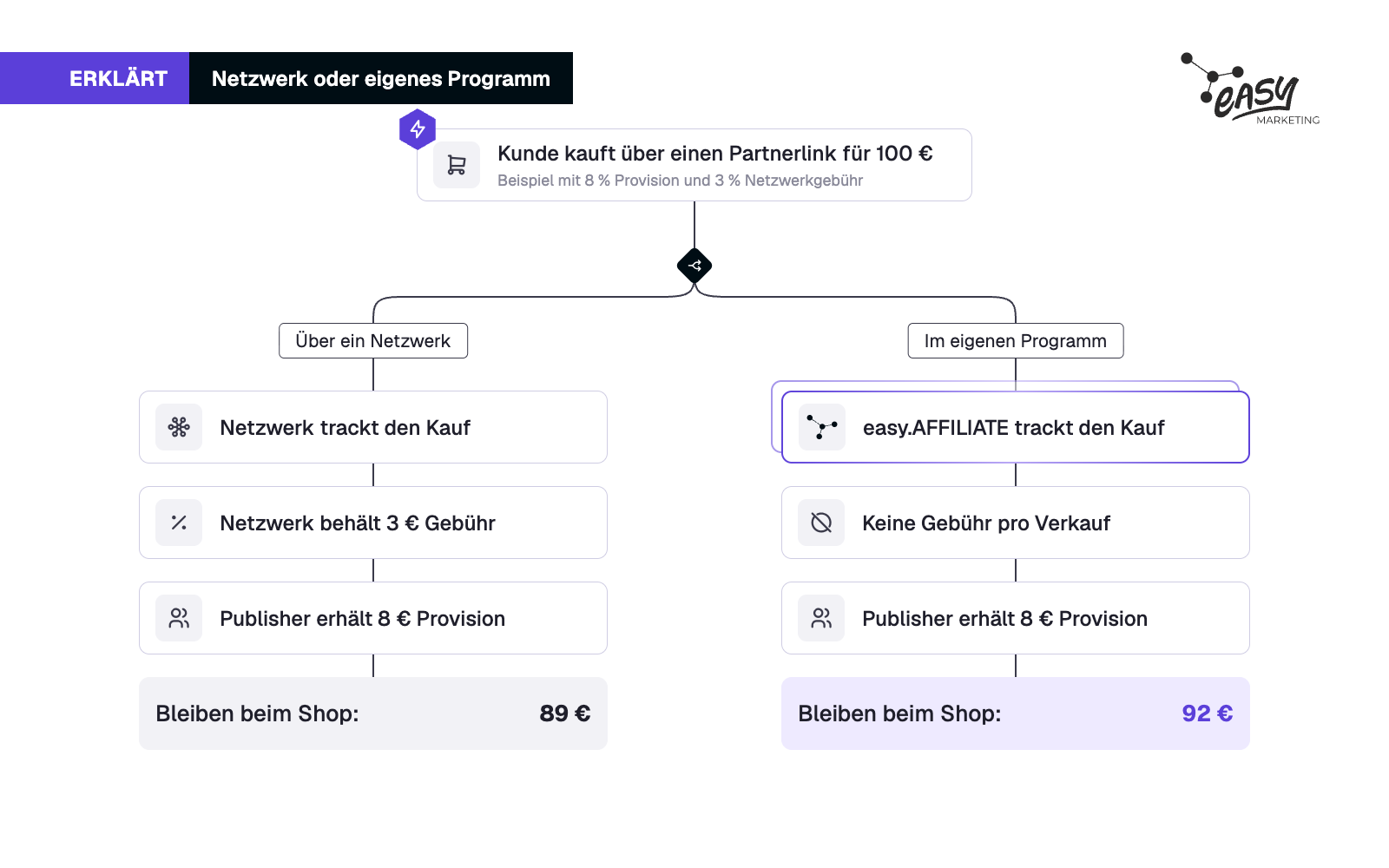
In a network, you pay a fee on every sale it brokers, on top of the commission to the publisher. That's convenient at first because there are hardly any fixed costs. As revenue grows, it gets expensive: with a 3% markup, one million euros in affiliate revenue costs you 30,000 euros in network fees, and at ten million it's 300,000 euros.
With your own program, you pay for the software and internal operations instead. With easy.AFFILIATE, that's a fixed monthly price per package that doesn't grow with your revenue. Your costs are predictable, and every additional euro from the channel goes straight to your margin.
Partner access and reach
This is where networks are strongest. From day one, you reach thousands of publishers looking for new programs. With your own program, you have to recruit partners yourself: through existing contacts, direct outreach, an application page and industry events.
For newcomers, this is a real advantage of the network. But if you already know your key partners, you often don't need the marketplace at all, because top publishers also work directly with advertisers.
Control over partners and terms
In a network, you operate within the framework the network sets: commission models, attribution, payout cycles and partner vetting. In your own program, you decide everything yourself. You can pay more for new customers than for existing ones, set your own cookie lifetime, define your own attribution rules and give each partner individual terms.
Data ownership
In a network, click, transaction and publisher data sit with the network, and you usually only see them as a finished report. In your own program, you have the raw data and can combine it with the rest of your marketing data, for example in your data warehouse. Data protection is simpler too: fewer parties are involved, and you know exactly where which data is processed.
Effort and staffing
What a network takes off your hands varies widely. Tracking and payouts to publishers usually run through the network. Personal account management, partner recruitment and communication are often only available as add-on services with their own fees. And you usually decide yourself which publishers get into your program anyway. With your own program, everything is up to you. How much work that means depends heavily on the software: at DOUGLAS, 99.85% of the day-to-day operations of its own network run automatically, and the team only steps in for exceptions. The DOUGLAS use case shows how DOUGLAS manages five countries in one system.
It's also worth noting that a network program doesn't run well without management either. If you want to scale seriously there, you'll also need someone in partner management or a managing agency.
Tracking and technology
Networks track via their own infrastructure, often still partly relying on third-party technology. With your own program, you can track server-side via a subdomain of your shop. This first-party tracking is more resilient to ad blockers and browser restrictions. We explain why in Benefits of first-party tracking with subdomains.
Decision matrix: which model is right for you?
| Starting point | Recommendation | Why |
|---|---|---|
| Newcomer with no partners and a small budget | Network | Quick reach, hardly any fixed costs, and you learn which publishers work |
| Growing shop with its first strong partners | Hybrid | Connect top partners directly, keep the long tail in the network |
| Established program with significant affiliate revenue | Your own program | Network fees exceed software costs; direct relationships with top partners |
| Multiple countries | Your own program | All markets in one installation instead of a separate program per country |
| Regulated industry (finance, healthcare) | Your own program or a specialist network | Full control over partners, ad materials and compliance |
Rule of thumb: Your own program pays off if you know where your key partners come from and your annual network costs are well above the software license plus internal effort.
Take the self-assessment
Network, hybrid or your own program: which is right for you?
Get your result in 2 minutes
Start the check →Common misconceptions
“Without a network, I won't find any publishers.”
A program's most important partners are usually a manageable group that you already know or can approach directly. Major voucher, cashback and comparison portals naturally work directly with advertisers too.
“Running your own program is only for large corporations.”
What matters isn't company size but channel volume and partner structure. Even mid-sized shops with a few strong partners often save noticeably with their own program.
"If I switch, I'll lose my partners."
Publishers aren't tied to a network. Check the notice periods and exclusivity clauses in your network contract and let your partners know early. Many are happy to switch if the terms are right.
"Running my own program means building it in-house."
Hardly anyone builds their own tracking and billing. The usual approach is licensed software that runs under your brand and is operated by a provider.
The middle ground: combining a network with your own program
Many large retailers don't choose one or the other – they opt for the hybrid model described above. The transition is usually gradual: you invite partners who consistently generate high revenue into your own program, while you test new partners in the network first until it becomes clear whether they matter.
What matters is a central data source, so you don't pay commission twice when a customer clicks links from both channels. easy.AFFILIATE automatically imports transactions from networks such as Awin, Tradedoubler or ADCELL, bringing reporting and billing together in one place.
FAQ
What is an affiliate network, in simple terms?
An affiliate network is a marketplace for affiliate programs. Advertisers list their programs there, publishers promote the offers, and the network handles tracking, contracts and billing. In return, it charges fees – usually a markup on every sale it generates.
Which affiliate networks operate in Germany?
The best known include generalists such as Awin, Tradedoubler, ADCELL and belboon, as well as financeAds, which specializes in financial products. Digistore24 is popular for digital products, and CJ is also widely used internationally.
Which is better: an affiliate network or your own affiliate program?
If you're just starting out without a partner base, a network is usually the better option. If you know your key partners and generate significant revenue through the channel, your own program saves you fees and gives you control over terms and data. For an assessment of your situation, try our affiliate program check.
Can I use a network and my own program at the same time?
Yes, the hybrid model is common among larger retailers. Central tracking is essential to make sure commissions aren't paid out twice.
How much does your own affiliate program cost?
You pay for the software and internal operations, but no fee on every sale. With easy.AFFILIATE, that's a fixed monthly price per package, plus one-time costs for setup and integration.
Conclusion
Affiliate networks are a good way to get started with affiliate marketing: fast reach, little effort and hardly any fixed costs. But the bigger your program grows, the more you pay for the same service – and the more you lack control and data. Your own affiliate program pays off once you know your key partners and network fees start to make a noticeable dent. For many, combining both is the best way forward.
Wondering whether your own affiliate program is right for you? In a free initial consultation, we'll look at your partner structure and your current network costs and give you an honest assessment of which model suits you. Book a demo
Still unsure? Start with the 2-minute affiliate program check.
Written by
Anja Heinicke
Head of Customer Success
Anja Heinicke is Head of Customer Success at EASY-M. As a former agency team lead at Artefact and in-house manager for global partnerships at Yazio, she spent years running campaigns herself. Today, she bridges the gap between tech and business for brands such as OTTO, MediaMarktSaturn and DOUGLAS.
Next step
Let's talk about your setup
In an initial call, we'll look at your goals together and show you which solution is right for you.
Tracking, web analytics and affiliate
Software and team based in Dortmund
Hosting exclusively in the EU
easy.AFFILIATE
Your own partner program, with no fee on every sale
Tracking, sales reconciliation and billing in one software. In use at DOUGLAS for more than 15 years.
Fixed price instead of network fees
Partner portal under your brand
Hosting exclusively in the EU


