

Without a solid data foundation, digital advertising is rarely profitable, and personalized user experiences are impossible. If you don't capture and recognize your users, you leave countless opportunities on the table. While the debate about the end of third-party cookies continues and Google has postponed their phase-out indefinitely for now, the requirements for data protection, transparency and user control keep rising – both technically and legally.
That's why companies that want to future-proof their online marketing rely on a privacy-friendly, stable and strategically smart way of collecting data in their own systems. This method is not only efficient but also independent of browser restrictions and external platforms, which makes it future-proof. On top of that, this type of tracking takes analysis and personalization to a new level.
Table of contents
- What is first-party tracking – and why does it matter so much?
- First-party tracking vs. third-party tracking: The key difference
- How does first-party tracking work technically?
- Cookies in tracking: Session vs. persistent
- What data first-party tracking can capture
- Why companies should rely on first-party tracking
- What companies need to consider when using first-party tracking
- Understand user behavior & increase conversions with first-party tracking
- Retargeting with first-party data: Precise, GDPR-compliant and independent
- Cross-platform tracking for a holistic customer journey
- Using first-party tracking correctly and avoiding common mistakes
- The future belongs to first-party tracking
What is first-party tracking – and why does it matter so much?
With first-party tracking, your own website, platform or app collects information about user behavior directly – without third parties such as Google, Facebook or other ad tech providers. Typical examples of the data collected include click behavior, time on page, scroll depth and shopping cart contents.
First-party tracking vs. third-party tracking: The key difference
The benefits of first-party tracking become especially clear when you compare it directly with third-party solutions:
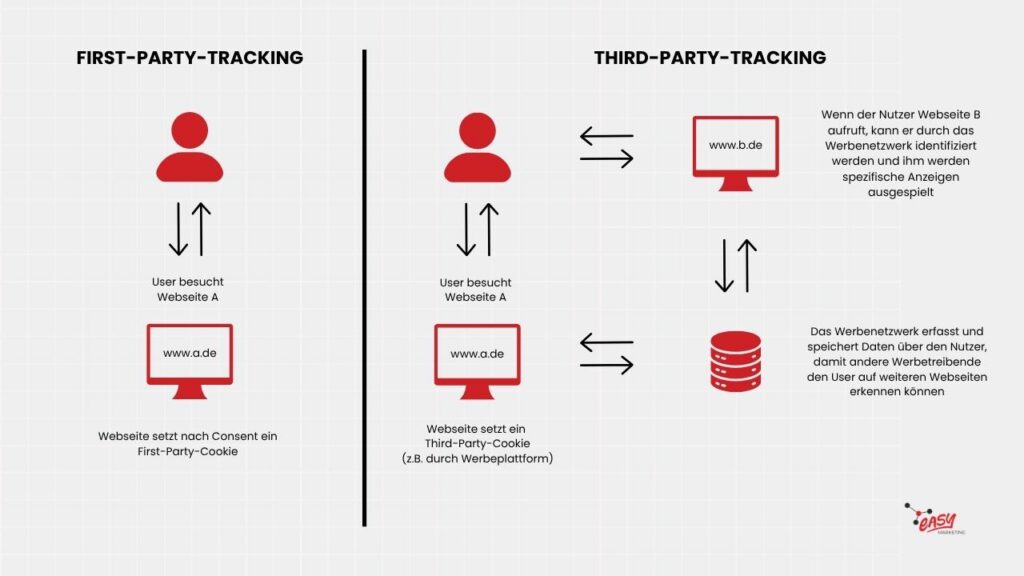
First-party tracking refers to data collected directly by the domain the user is currently visiting. The information comes straight from the interaction between the visitor and the website, platform or app – without any detour via external providers. The operators capture, store and analyze the data themselves. Example: The online shop beispiel-shop.de sets a cookie to analyze user behavior or to save a customer's shopping cart.
Third-party tracking, on the other hand, means that third-party providers – services that don't belong to the website – are integrated. They set their own cookies or tracking scripts to identify visitors across different websites. Prominent examples include the Facebook pixel or Google Analytics in its classic client-side implementation. In this case, the data ends up on external platforms, which often process it for their own purposes. Facebook, for example, can track the user's behavior on other websites as well and build a user profile of that person (or enrich an existing profile with additional data).
Why this difference is crucial
First-party tracking is increasingly becoming the standard because it offers significant advantages in terms of data protection and data ownership:
- First-party data belongs to the company that collects it. It gives you maximum control and allows legally compliant use within your own systems. Unlike with third-party tracking, this data stays entirely within the company's sphere of control. This not only improves data quality and availability but is also a clear advantage – especially with regard to current data protection standards such as the GDPR
- Third-party data often comes with additional risks such as a lack of transparency, dependence on third parties and data flows that are problematic under data protection law (especially transfers to the US)
Technical developments and regulatory requirements are reinforcing this trend. Safari and Firefox have been blocking third-party cookies for several years (Safari with ITP and Mozilla with ETP), and Google also planned to follow suit in its Chrome browser in 2025 but decided against it for the time being. At the same time, requirements for data protection and data responsibility are growing due to the General Data Protection Regulation (GDPR), the Digital Markets Act (DMA) and other international regulations.
On desktop devices in Germany, Safari and Firefox together account for a market share of just over 17% of pageviews. This means 17% of all desktop users are excluded from third-party tracking by default. On mobile, Safari's market share is significantly higher at 30%. Here, almost 1/3 of all pageviews are no longer captured by third-party tracking but blocked directly by the browser.
In a nutshell: The benefits of tracking without third parties
- No dependence on third-party scripts or platforms
- Full control over your data and how it is stored
- Higher data quality and better integration options (e.g. into CRM, CDP or BI systems)
- Legally compliant use thanks to your own control and transparent processes
- Much higher tracking rates for more reliable data analysis
The General Data Protection Regulation (GDPR) and first-party tracking
When the GDPR came into force in 2016, it fundamentally changed digital marketing in Europe, especially in how personal data is handled. Europe took the lead on data protection. In 2020, the US state of California introduced the California Consumer Privacy Act (CCPA) – the first major comprehensive privacy legislation in the US, based on the GDPR.
How does first-party tracking align with GDPR requirements in 2025?
It is important to note that first-party data is not automatically GDPR-compliant. The same basic principle applies here: personal data may only be collected and processed if there is a legal basis – e.g. consent (Art. 6(1)(a) GDPR) or legitimate interest (Art. 6(1)(f) GDPR). Conversely, this means that if there is neither a legitimate interest nor consent, collecting the data is not permitted, even with first-party tracking.
What is personal data and what does it mean for tracking?
Under the GDPR, personal data is any information that relates directly or indirectly to an identified or identifiable person. This includes, for example, IP addresses, device information and location data as well as e-mail addresses, customer IDs and login data. Usage data such as click behavior, scroll depth or unique cookie IDs can also be personal data as soon as it can be linked to a person.
Data protection benefits of first-party tracking:
- Data ownership stays with the company
- Transparency & control over data collection and use
- Consent can be obtained in context and precisely
- Legally compliant use is easier to demonstrate (e.g. Art. 5(2) GDPR)
- The balancing of interests for legitimate interest often turns out more favorably
What companies need to consider:
- Valid consent management with clear choices
- A transparent privacy policy
- The option to withdraw consent at any time
- Technical safeguards such as pseudonymization or IP anonymization

How does first-party tracking work technically?
First-party tracking relies on several technologies that let a website collect and store user data directly via the browser. The foundation is JavaScript tags and first-party cookies, while local storage and, above all, server-side tracking are becoming increasingly important. Besides improving tracking rates, these approaches also give you better data protection and more control over the data you collect. In practice, by combining these technologies we achieve tracking rates of up to 98.4% for our customers.
Client-side tracking with JavaScript tags
When someone visits a website, the web server sends the page's HTML code to the user's browser. This code often contains <script> tags, which load JavaScript code that runs directly in the browser. These scripts collect data on user behavior, including:
- Clicks and mouse movements
- Scrolling behavior and time on page
- Device and browser information
The collected information is usually sent to the server of your own domain via HTTP requests (e.g. using POST or GET).
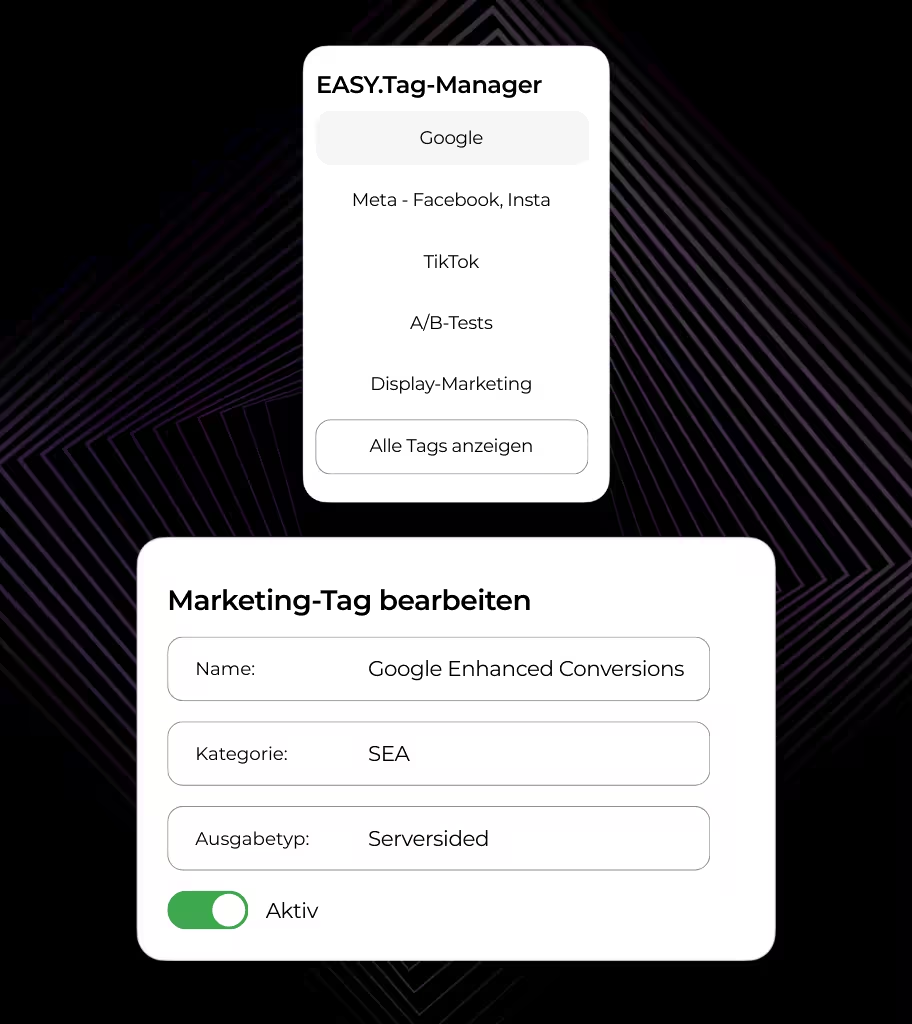
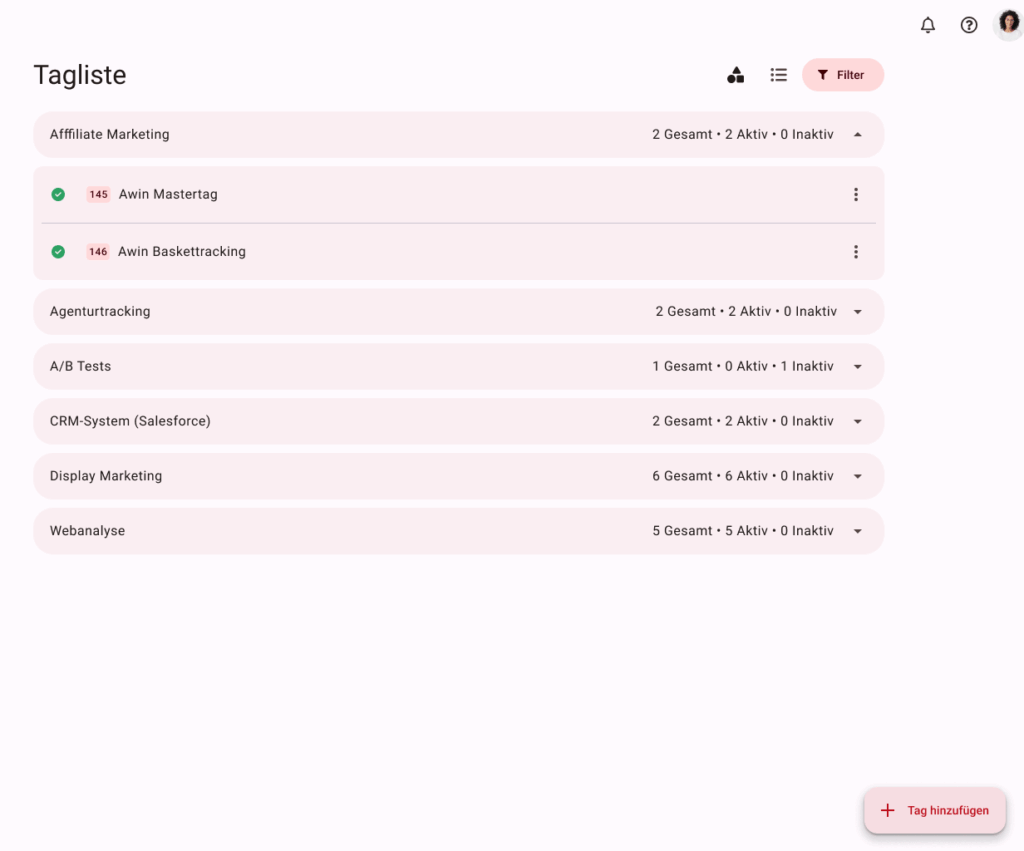
Tag management systems such as the easy Marketing Tag Manager or Google Tag Manager make these scripts easy to manage. They let you control tracking tags centrally without having to change the website's source code directly, so tags can be managed without technical expertise. The easy Marketing Tag Manager can always be deployed as a first-party tag manager at no extra cost and is available to all our customers.
Server-side tracking
With server-side tracking, data isn't processed directly in the user's browser but on the web server of your own domain. The website communicates with the browser, captures interactions and sends them over secure server-to-server connections to your own systems (for example, the easy Marketing tracking system) or to selected privacy-compliant third-party providers.
Benefits of server-side tracking:
- Independence from browser-based cookie blockers and tracking prevention tools
- Better control over data quality
- Sensitive data can be processed securely on the server
- Precise control over which information is shared with third-party systems
- Website or app performance can improve: fewer client-side scripts mean faster load times, less JavaScript overhead and lower data usage on mobile devices
- Data can be fed directly into a data warehouse, CRM, CDP or BI tool
Depending on the system, implementation can be more or less complex, especially with public cloud providers such as Google Cloud. At easy Marketing, we offer an integrated solution for first-party and server-side tracking that significantly reduces this complexity. Book a free initial consultation with our experts now.
Cookies in tracking: session vs. persistent
Cookies play a central role in online marketing tracking. There are two main types of cookies:
Session cookies
- Exist only for the duration of a session
- Store temporary information such as shopping cart contents, login status or language settings
- Are deleted automatically when the browser is closed
- Use case: analyzing user behavior within a session
Persistent cookies
- Remain even after the browser is closed
- Store long-term data such as tracking IDs, language settings or user profiles
- Lifetime: from days to several months
- Use case: recognizing returning visitors, conversion tracking over longer periods
Practical example: cookies in affiliate marketing and e-commerce
Persistent cookies are especially relevant in affiliate marketing, for example, where they govern how commissions are assigned. A sale is credited based on the cookie's lifetime. Platforms such as Amazon allow tracking for up to 90 days, although this period varies by partner program. Session cookies, on the other hand, are used in online shops to keep products in the shopping cart. At the same time, a persistent cookie can be set to show the user personalized recommendations on their next visit, based on their previous behavior.
Under the GDPR, both types of cookies require consent as soon as they store personal data or analyze user behavior for marketing purposes. A transparent cookie banner with granular choices is mandatory here.
What data first-party tracking can capture
What matters is not only which data is collected, but also how it is used and protected.
Overview of typically collected data
CategoryExample dataTechnicalIP address, browser type, operating systemBehaviorClick paths, scroll depth, time on pageSourceReferrer URL, campaign parameters (UTM)InteractionForm usage, downloads, video viewsE-commerceCart actions, checkout abandonments, purchasesReturn visitsVisit frequency, time between visits
Data from other systems can also be added to refine these profiles, for example an e-mail address (after login or registration), a customer ID (from CRM systems) or a device ID (for app usage). This is exactly where the strength of first-party data collection lies. You can use this self-collected data in your CRM to refine customer profiles, in your data warehouse for in-depth analysis and in marketing automation platforms for targeted triggers such as personalized content or e-mails. But here, too, the same rule applies: as soon as data is linked to or stored with a user profile, active consent is generally required.
Why companies should rely on first-party tracking
The demands on modern online marketing have changed fundamentally in recent years. Users expect relevance and privacy at the same time, platforms are becoming more restrictive and legal requirements call for more transparency. If you want to succeed in the digital space today, you don't just need data – you need the right data in the right place.
First-party tracking gives companies exactly that: a reliable data foundation that remains entirely under their own control. Unlike with third-party providers, you can design and document every step of data collection, processing and use yourself. This not only provides legal certainty but also the flexibility to use data strategically for sales, analytics and automation.
Switching to modern tracking technology also pays off financially. Stable tracking rates, less data loss and higher data quality directly boost your performance – whether in segmentation, retargeting or UX optimization. At the same time, you strengthen your customers' trust through transparent processes and careful handling of sensitive information. Companies that rely on first-party tracking are investing not just in modern technology, but in a future-proof data strategy that is independent, scalable and GDPR-compliant – and that offers numerous competitive advantages.
What companies need to consider when using first-party tracking
As powerful as first-party tracking is, implementing it also comes with challenges that companies should approach strategically. Moving to a privacy-compliant, future-proof tracking infrastructure requires clear decisions and a good understanding of your own data landscape.
- Technical requirements and system architecture
It's not a plug-and-play system. Unlike third-party solutions, first-party solutions require server integration, custom data models and regular technical maintenance. Many standard solutions on the market – such as those from Google – are either technically complex, difficult to implement in a privacy-compliant way or expensive. At easy Marketing, we deliberately rely on an architecture built for first-party tracking from the ground up, which you can use at no extra cost – including easy integration via our own platform.
- Investing time, budget and expertise
Building a robust first-party strategy takes time for planning and alignment, budget for tools and systems, and in-house or external expertise. We support you with proven know-how and a team that specializes in first-party tracking – from concept to day-to-day operation.
- Actively manage consent: consent as a success factor
Without valid consent, nothing works. A professional consent management platform (CMP) is a must and the prerequisite for valid, usable tracking data. Transparency, usability and legal precision are crucial here.
- Break down data silos and connect your systems
First-party data is generated in many systems: CRM, web analytics, newsletter tools or e-commerce platforms. Without central data storage, for example in a customer data platform or a DWH, key insights remain disconnected. Our infrastructure lets you seamlessly connect all relevant systems – including server-side processing.
- Privacy-compliant data processing through anonymization & pseudonymization
Companies must ensure that their data processing complies with data protection rules and purpose limitation. This requires clear processes, technical security measures – and the knowledge of how to bring the two together.
- Change needs buy-in
Many teams have relied on third-party data, standard dashboards and familiar tools for years. Switching to first-party tracking therefore also requires internal education, training and new ways of thinking. If you invest early, you will later benefit from more control, better data quality and greater independence.
Understand user behavior & increase conversions with first-party tracking
One of the biggest levers in digital marketing is optimizing your own website. First-party data lets you capture user behavior precisely, analyze it in a fully privacy-compliant way and derive concrete measures for conversion optimization. This gives you reliable data for measurable results.
What first-party tracking makes measurable:
• Click behavior on buttons, links and calls to action
• Scroll depth and time spent on individual pages
• Drop-off rates for forms or registrations
• Behavior in the checkout process and shopping cart analysis
• Impact of loading times and navigation structure on user behavior
How you benefit in practice:
• Run A/B tests effectively: first-party data shows you exactly which variant performs better – broken down by device, user group or traffic channel.
• You can see where users drop off and take targeted countermeasures
• Data-driven insights help you surface and prioritize important content and elements
Retargeting with first-party data: precise, GDPR-compliant and independent
Classic retargeting, as implemented via the Facebook pixel or Google Ads, is based on third-party cookies. First-party retargeting works without third-party providers, directly through your own system. This allows you, for example, to re-engage customers who abandoned their purchase with targeted e-mails or onsite banners. Dynamic content that adapts to previous behavior on a return visit is also easy to implement. In addition, you can also sync with Google or Meta – not via external trackers, but via hashed first-party data such as e-mail addresses. You can even create lookalike audiences this way without sharing personal information with third parties.
The big advantage: first-party retargeting works regardless of cookie blockers, can be properly documented and meets the requirements of the GDPR. Because the data is collected and processed directly on your own domain with users' active consent, you stay in control at all times. This significantly improves audience targeting and also makes your budgets more efficient.
Cross-platform tracking for a holistic customer journey
Modern customer journeys are complex: a potential customer clicks on an ad on their smartphone, reads product information on their desktop and later completes the purchase on their tablet. To capture and evaluate all these touchpoints accurately, you need a solution that works across platforms and devices – and this is exactly where first-party tracking shows its full strength.
By using unique identifiers such as login data or first-party IDs, users can be recognized across different devices and their interactions merged. This requires central data storage in which information from web, app, shop and other channels is linked in a GDPR-compliant way. The server-side infrastructure from easy Marketing does exactly that: data from all platforms is consolidated in one central source, analyzed in real time and – if needed – connected to BI or DWH systems. The result is a complete picture of the customer journey – regardless of channel or device.
Using first-party tracking correctly and avoiding common mistakes
In practice, we keep coming across pitfalls that are easy to avoid – with structure, expertise and the right tools. Common mistakes include missing or incomplete consent management, unclear tracking goals, unintentionally mixing first- and third-party components, and a lack of quality assurance after implementation. Failing to analyze the data also means valuable insights go unused.
Our recommendation: define clear goals from the start, make sure your first-party setup is clean and free of external trackers, and invest in a strong CMP and an analytics environment. We support you at every step with more than 15 years of tracking experience and a system developed specifically for these requirements.
The future belongs to first-party tracking
With third-party cookies being phased out, increasing regulation through laws such as the DSA and DMA, and growing user awareness of data protection, first-party tracking is shifting from a trend to the new standard.
Future developments such as the stronger shift to server-side tracking, AI-powered personalization and the growing importance of CDPs make one thing clear: companies that invest in their own robust data strategy today gain long-term advantages. Data protection is increasingly becoming a differentiator – not only with customers, but also against the competition.
Taking responsibility means collecting only the data you actually need, being transparent about how it is processed and using all information in a purpose-bound, traceable way. That is exactly what we enable at easy Marketing – with an EU-hosted first-party tracking solution that is powerful, privacy-compliant and future-proof. Book a free initial consultation with our experts now to find out what is possible for your company.